803.1864.Nature and God—I neither knew

803.1864.Nature and God—I neither knew

“Two fair copies, variant, about 1864 and 1865. A pencil copy signed “Emily” was sent to Samuel Bowles about early 1864” (a 698, Franklin 1998).

One alternate word in Line 5, but I prefer ED’s original “My” over its alternate, “an”, because it is more personal than “an” and because it’s in her 1864 first variant, which she sent to Bowles:

Nature and God—I neither knew
Yet Both so well knew me
They startled, like Executors
Of My (an) identity.

Yet Neither told—that I could learn—
My Secret as secure
As Herschel’s private interest
Or Mercury’s affair—


My interpretation of ‘Nature and God’ (Fr803) in two paragraphs, one for each stanza:

Stanza 1: I knew neither Nature nor God, yet both thought they knew me well. When they learned about my real identity, they startled, like surprised executors of my will.

Stanza 2: Yet neither told, as far as I could learn; my secret was as secure as William Herschel’s private life as a musician and composer, or Mercury’s love affair with Venus.


To ED, her relationship with Wadsworth would be much more surprising to “Nature and God” than knowledge that she was a world-class poet.


Aside from his astronomical discoveries, Herschel played violin, oboe, harpsichord, and organ. He composed 24 symphonies, several concertos, and church music. In addition, he served as a church organist in Bath and led a military band (Google AI).


Mercury, the Roman messenger god, had a romantic affair with Venus, the goddess of love, which resulted in the birth of their child, Hermaphroditos (Google AI).


ED’s deepest secret was that for five years (1856-1860), she had cultivated an epistolatory friendship with Philadelphia’s superstar Presbyterian minister, Reverend Charles Wadsworth. Apparently, ED shared knowledge of her relationship with no one except Eliza Coleman, her second cousin and close friend since childhood (see my explications of the two previous poems, Fr801 and Fr802). ED kept her friendship with Wadsworth a secret to protect both his reputation and her own.

The payoff for her long labor was his 1860 visit to her home in Amherst.

Apparently, during September 1861, Wadsworth informed ED that he would relocate to a different pulpit. What he didn’t tell her was his reason for leaving Arch Street Presbyterian. Though he sided with the Union politically, he firmly believed the Bible condoned slavery. Most of his Philadelphia congregation did not agree and asked him to resign.

Apparently, when Wadsworth told ED he would be relocating, ED went into an emotional tailspin of incredible poem production and bipolar depression. As she told Higginson in her second letter to him (JL261, MML338, postmarked April 28, 1862):

“I had a terror – since September – I could tell to none – and so I sing, as the Boy does by the Burying Ground, because I am afraid”

“Sing” she did; Franklin dates 227 poems to 1862 and 295 to 1863.

The only surviving letter from Charles Wadsworth to Emily Dickinson is dated “about late April, 1862” by M&M (2024). That he misspelled her name in the salutation suggests carelessness or ignorance:


“My dear Miss Dickenson [sic]

I am distressed beyond measure at your note, received this moment,—I can only imagine the affliction which has befallen, or is now befalling you

Believe me,—be what it may, you have all my sympathy, and my constant, earnest prayers—

I am very, very anxious to learn more definitely of your trial—and though I have no right to intrude upon your sorrows Yet I beg you to write me, though it be but a word;

In great haste

Sincerely and most
Affectionately Yours—”


Unsigned, but “Yours” underlined. The stationary had an embossed “C.W.” crest on it. Wadsworth never used that stationary after leaving Philadelphia.

Wadsworth says he replied immediately after receiving a disturbing “note” from ED, which would have been sometime in April 1862, just before he sailed from New York Harbor on May 1.


PS1. “The most crucial and — though she could not know it — historically eventful year in Emily Dickinson’s life was 1862. She was undergoing an emotional disturbance of such magnitude that she feared for her reason. At the same time she had developed her poetic sensibilities to a degree that impelled her to write Thomas Wentworth Higginson in April to learn what a professional man of letters might have to say about her verses. In no other year did she ever write so much poetry.” (Franklin 1986)


PS2. Google AI’s definition of executor: The person named in a will to manage a deceased person’s estate.


Franklin, RW (ed). 1986.The Master Letters of Emily Dickinson. Amherst College Press

Miller, Christine and Dohmnall Mitchell. 2024. The Letters of Emily Dickinson. Harvard University Press. Kindle Edition.
802.1864.The spry Arms of the Wind

802.1864.The spry Arms of the Wind
“About early 1864, in pencil on both sides of an envelope addressed to Miss Emily Dickinson (a140)” (Franklin 1998)

I prefer all three of ED’s alternate words (parentheses in Lines 1 & 10):

The spry (long) Arms of the Wind
If I could crawl between
I have an errand imminent
To an adjoining Zone—

I should not care to stop
My Process is not long
The Wind could wait without the Gate
Or stroll the Town among.

To ascertain the House
And is (if) the soul (soul’s) at Home
And hold the Wick of mine to it
To light, and then return—

My interpretation of ‘The spry Arms of the Wind’ in three prose paragraphs, one for each stanza:

Stanza 1: “The (long) Arms of the Wind” separate Earth and Heaven, which is “an adjoining Zone”. I would like to “crawl between” those “Arms” because I have “an errand imminent” in Heaven.

Stanza 2: Not only is my “errand imminent”, it will also be quick: “My process is not long”. ED then suggests “The Wind could wait outside the Gate / Or stroll the Town” within, AKA Heaven.

Stanza 3: My “errand imminent” is to “ascertain the House” where Wadsworth’s soul lives “and, if the soul’s at Home”, to “hold the Wick of my soul to it / to light, and then return” to Earth with Wadsworth’s flame of “Life Force”, her muse’s poetic inspiration, the thing that makes my life worth living.

……………………………………

Franklin (1998) describes the Fr802 manuscript: “About early 1864, in pencil on both sides of an envelope addressed to “Miss Emily Dickinson” (a140). The “a140” indicates this manuscript is Item “#140 in the Amherst College Emily Dickinson collection.

802.1864.The spry Arms of the Wind
“About early 1864, in pencil on both sides of an envelope addressed to Miss Emily Dickinson (a140)” (Franklin 1998)

I prefer all three of ED’s alternate words (parentheses in Lines 1 & 10):

The spry (long) Arms of the Wind
If I could crawl between
I have an errand imminent
To an adjoining Zone—

I should not care to stop
My Process is not long
The Wind could wait without the Gate
Or stroll the Town among.

To ascertain the House
And is (if) the soul (soul’s) at Home
And hold the Wick of mine to it
To light, and then return—

My interpretation of ‘The spry Arms of the Wind’ in three prose paragraphs, one for each stanza:

Stanza 1: “The (long) Arms of the Wind” separate Earth and Heaven, which is “an adjoining Zone”. I would like to “crawl between” those “Arms” because I have “an errand imminent” in Heaven.

Stanza 2: Not only is my “errand imminent”, it will also be quick: “My process is not long”. ED then suggests “The Wind could wait outside the Gate / Or stroll the Town” within, AKA Heaven.

Stanza 3: My “errand imminent” is to “ascertain the House” where Wadsworth’s soul lives “and, if the soul’s at Home”, to “hold the Wick of my soul to it / to light, and then return” to Earth with Wadsworth’s flame of “Life Force”, her muse’s poetic inspiration, the thing that makes my life worth living.

……………………………………

Franklin (1998) describes the Fr802 manuscript: “About early 1864, in pencil on both sides of an envelope addressed to “Miss Emily Dickinson” (a140). The “a140” indicates this manuscript is Item “#140 in the Amherst College Emily Dickinson collection. In 1958, Mabel Todd’s daughter,  Millicent Todd Bingham, gave ED’s manuscripts of Fr801 and Fr802 (a140 and a438) to the Amherst College Library. (Google AI)


My inference is that ED wrote Fr801 on the first envelope Eliza sent to ED, folded it, and placed it inside a cover envelope that she addressed to Eliza.

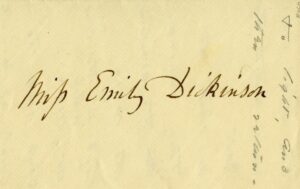
What Franklin doesn’t tell us is that the folded envelope with ED’s poem “on both sides” includes her last two lines on the outside of the flap used to seal the original envelope and that her last two poem lines straddle Eliza’s elegantly written “Miss Emily Dickinson”. Eliza indicated the double “ss” in “Miss” with the German “eszett” symbol, ß.

Eliza knew ED would recognize the “eszett” symbol because in 1847, when ED was 16, she and Eliza had studied German together at Amherst Academy (Habegger 2001). Given this information, when ED wrote Fr802 the friendship between her and Eliza had lasted 17 years (1847-1864).

For a list of reasons why I think both Fr801 and Fr802 are about Wadsworth, see my explication of Fr801 on the ED-LarryB blog.


Franklin, R. W. 1998. THE POEMS OF EMILY DICKINSON: VARIORUM EDITION. Edited by R. W. Franklin. 3 vols. Cambridge, MA: Belknap P of Harvard UP, 1998. vi + 1654 pp.

Habegger, Alfred. 2001. My Wars Are Laid Away in Books: The Life of Emily Dickinson Random House Publishing Group. Kindle Edition.


801.1864.As Sleigh Bells seem in summer

801.1864. As Sleigh Bells seem in summer
“About early 1864, in pencil on the inside of an envelope addressed by ed to Eliza Coleman in Philadelphia (a 140)” (Franklin 1998)

I prefer all four of ED’s alternate words (parentheses in Lines 1, 3, 6, 8):

As Sleigh Bells seem (sound) in summer
Or Bees, at Christmas show —
So fairy (foreign) — so fictitious
The individuals do

Repealed from observation —
A Party that (whom) we knew —
More distant in an instant
Than Dawn in (on) Timbuctoo.


My interpretation of Fr 801 in two prose sentences:

Lines 1-4: As sleigh bells sound in summer or bees at Christmas show, a person I knew seems so foreign, so false, reversed from his former self.

Lines 5-8: My Master has become a person “More distant in an instant, than Dawn on Timbuctoo.”

……………………………………….

There are at least seven reasons we can assume that Eliza Coleman, ED’s close friend and second cousin, understood the camouflaged meaning of this poem and that Wadsworth was ED’s “Master”:

  1. Franklin (1998) tells us this poem’s manuscript was written in pencil on the inside of an envelope addressed by ED to Eliza Coleman in Philadelphia”.
  2. When ED was 16, she and Eliza studied German together at Amherst Academy. The instructor was Eliza’s father, who resigned midsemester from Amherst Academy and moved to Philadelphia to headmaster a new women’s academy.
  3. In March 1855, Eliza Coleman invited ED and Lavinia to visit her in Philadelphia, where the Colemans were members of Arch Street Presbyterian Church and Reverend Charles Wadsworth was their minister. Wadsworth was a superstar Presbyterian minister in Philadelphia and considered one of the finest Presbyterian ministers in America.
  4. Habegger (2001), ever the careful historian, tells us “[I]t is thought Dickinson was taken to the Arch Street Presbyterian Church to hear the Reverend Charles Wadsworth preach and that he made such an impression on her she later solicited his counsel and thus initiated one of her most vital friendships”.
  5. On April 12, 1861, Confederate cannons bombarded Fort Sumpter, and in December 1861 Wadsworth resigned his prestigious Philadelphia pulpit. The reason was that he believed the Bible condoned slavery (“Curse of Ham”, Genesis 9:22-26, KJV), but his congregation did not and asked him to leave. ED didnt know his reason for resigning and probably assumed it was her fault; perhaps his close friendship with ED had been discovered by his Arch Street congregation.
  6. On May 1, 1862, Wadsworth and his family sailed to San Francisco, where he rescued a floundering Calvary Presbyterian Church before returning to Philadelphia in 1869.”
  7. Given the close friendship of ED and Eliza for 17 years, 1847-1864, and Eliza’s invitation in March 1855 to introduce ED to Wadsworth’s powerful preaching, I think Eliza was fully aware by “early 1864” that Wadsworth was ED’s “Master”. I think it likely she understood the cryptic meaning of ED’s ‘As Sleigh Bells seem in summer’ (Habegger 2001).

For these reasons, I think Wadsworth was the “Party whom we knew — / More distant in an instant”.


Franklin, R. W. 1998. THE POEMS OF EMILY DICKINSON: VARIORUM EDITION. Edited by R. W. Franklin. 3 vols. Cambridge, MA: Belknap P of Harvard UP, 1998. vi + 1654 pp.

Habegger, Alfred. 2001. My Wars Are Laid Away in Books: The Life of Emily Dickinson (p. 376). Random House Publishing Group. Kindle Edition.


800.1864.I never saw a Moor

I never saw a Moor
I never saw the Sea –
Yet know I how the Heather looks
And what a Billow be –

I never spoke with God
Nor visited in Heaven –
Yet certain am I of the spot
As if the Checks were given

That second stanza seems completely out of character for ED. Poem after ED poem has put her in last place as a person “certain” about “Heaven. She’s got to have an ulterior motive for this stunner.

I think she’s  trying to get well meaning Christians off her back with a superficially strong statement of faith. Most Christians would read the second stanza as if it were literally true. Rarely would a perspicacious reader smell a “whiff of artifice”, as Adam DeGraff did on The Prowling Bee.

ED learned to cover her tracks first hand. Apparently, many Amherst tongues wagged when she mailed her first letter to Charles Wadsworth at the local post office, where a gossipy post mistress spread the word. After that embarrassment, she had Dickinson employees or friends mail her letters in nearby towns, or, to be safer, she mailed her private letters by sending them in innocent-looking cover envelopes to trusted friends in more distant towns for forwarding.

799.1864.All I may, if small —

All I may, if small,
Do it not display
Larger for the Totalness —
’Tis Economy

To bestow a World
And withhold a Star —
Utmost, is Munificence —
Less, tho’ larger, poor.

An edited interpretation, my inserts in [brackets]. I read Lines 4 and 5 as enjambed.

[I give] All I may [am], [even] if [it’s] small.
Do[es] it not display
Larger for the [its] Totalness [?]
’Tis Economy
To bestow a World
And withhold a Star[.]
[Giving] Less, tho’ larger, [is] poor [stingy].

A prose interpretation:

I give all I am, even if it’s small. Doesn’t that display larger because of its Totalness? Perhaps ‘tis Economy to bestow a World and withhold a Star, but that is less, tho’ the gift is larger, than the gift of myself.

When Wadsworth “abandoned” ED in 1862 by moving to San Francisco, I think she resolved to “give” the remainder of her life to poetry and to remain faithful to him. To symbolize her sacrifice of a “normal” life, if there were any chance of a “normal” life for someone like ED, she wore only white for the remainder of her life and asked to be buried in a white coffin. Her last letters prove that she loved him until the day she died.

I know, too much biography.

798.1864.The Veins of other Flowers

The Veins of other Flowers
The Scarlet Flowers are
Till Nature leisure has for Terms
As “Branch,” and “Jugular.”

We pass, and she abides.
We conjugate Her Skill
While She creates and federates
Without a syllable.

Do you know your birds? Do you know the muscles, bones, and organs of the cat we dissected in Biology lab? What is that wildflower called? When we learn these names, we say we “know” something about nature. ED asserts in these eight lines, we know nothing about nature, about physical reality. If we spoke a different language, those English names would be meaningless, but birds, bones, and wildflowers would be the same, as they were long before humans invented languages.

Our faux knowledge of nature is a symptom of a mindset disease we call anthropocentrism. It’s a disease that explains why we all pump too many fossil CO2 molecules that will gradually reduce quality of life of our grandchildren and much more so their descendants for a thousand generations. With whatever plant and animal species we leave extant when our dark curtains fall, Nature will “create and federate / Without a syllable”.

ED was a prescient poet.

797.1864.The Definition of Beauty is

The Definition of Beauty is
That Definition is none—
Of Heaven, easing Analysis,
Since Heaven and He are one.

I read Line 2 as a repetition of Line 1 after a brief pause and Lines 2-3 as enjambed, one continuous sentence with no or, at most, a miniscule pause between “none” and “Of”:

“The Definition of Beauty is . . . ., That Definition is none Of Heaven, easing Analysis, since Heaven and He are one.”

ED tells us the gender of Beauty is male; that and the capitalized “He” immediately identify Beauty as Wadsworth. No need to guess about philosophical interpretations, ED eased our Analysis.