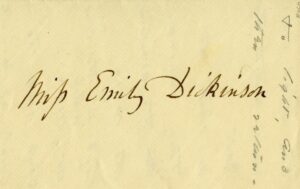
771.1863.We miss her not because we see

ED’s alternative words in parentheses; my emendations in brackets

We miss Her, not because We see—
The Absence of an Eye—
Except it’s Mind accompany [is also absent and]
Abridge (Deprive) Society[.]

As slightly (scarcely) as the Routes (Flights) of Stars—
[Deprive] Ourselves—asleep below [of sleep, yet]
We know that their superior Eyes
Include Us —as they go—[.]


Initially, I thought the first and second stanza were enjambed, creating a logical fallacy, but a period at the end of Stanza 1 solved the problem. If Stanza 1 is a complete thought, then Stanza 2 also becomes a complete thought and ends with a period. With ED’s alternate words in parentheses and my emendations, each stanza becomes a prose sentence:

“We miss Her, not because We see— / The Absence of an Eye— / [Unless] its Mind [is also absent, and] / (Deprive)[s] Society[.]

“As slightly as the (Flights) of Stars— / [Deprive] Ourselves—[of sleep] below—[,] / [Yet] We know that their superior Eyes / Include Us — as they go—[.]”

…………………………………………

When ED says she misses some influential person who looks down on us from the stars, my immediate hypothesis is Elizabeth Barrett Browning (1806-June 1861), whose 11,000-line poem/novel, ‘Aurora Leigh’, called for recognition of female poets and captured ED’s subconscious “white hot” poem forge. ED “owned two copies of ‘Aurora Leigh’ [1856], and one contains passages she marked in pencil, indicating careful reading and engagement with the text” (en.wikipedia.org/wiki/Victorian Web).

We know that EBB’s death was heavy on ED’s mind in late October, 1861, when she wrote her cousin, Louisa Norcross (JL311):

“Mrs Browning  . . . and George Sand (1804-1876), women, now, queens, now! And one in the Eden of God. I guess . . . little stars . . . twinkling at last. Take heart, little sister, twilight is but the short bridge, and the moon stands at the end. If we can only get to her! Yet, if she sees us fainting she will put out her yellow hands.”

……………………………

ED’s two manuscripts of Fr771, Variants A and B, use “ït’s” as possessive, which is incorrect by modern standards. A quick check of 20 poems, F771-F790, turned up two more examples of this “error” in ED’s handwriting. Google AI has this to say:

“The possessive form “its” without an apostrophe became the accepted possessive form in the 18th century, replacing the earlier usage of “it’s” with an apostrophe. Originally, “it’s” was used for both the possessive and the contraction.” Much of ED’s reading was pre-1800 books, and the same was true of ED’s contemporary, Herman Melville, who frequently used “it’s” as both possessive and a contraction.

770 1863.Strong draughts of their refreshing minds

Strong Draughts of Their Refreshing Minds
To drink – enables Mine
Through Desert or the Wilderness
As bore it sealed Wine

To go elastic – Or as One
The Camel’s trait – attained –
How powerful the stimulus
Of an Hermetic Mind –

The “it” in Line 4 refers to “Mine” (my mind) in Line2. Line 4 translates as “As if my mind bore sealed Wine”. The “Hermetic Mind” in Line 8 refers to and slant rhymes with “sealed Wine” in Line 4.

“Hermetic” in Line 4 implies a mind sealed in both directions, in and out. ED probably did not mean a closed mind, but that’s what her words imply. Possibly she meant a mind resistant to the latest fashions in public discourse, poetic styles, or religious dogma. David Preest lists Elizabeth Barrett Browning and George Eliot as likely leaders on Emily’s List of “Hermetic Minds”.

 ED has convinced me that virtually all of her poems have two or more levels of meaning: poetic and historical. These levels cannot be separated into two ivory towers, as most academics do.

The reason for her instant and continuing public adulation (1890-present) was and is, by far, poetic. She is one of the “Greats” that she always dreamed to be, despite her lifelong refusal to publish. That refusal freed her from criticism and allowed her to explore the outer boundaries of poetic power.

Her refusal to publish was only possible because of the lifelong financial and daily social/housekeeping support of her family, especially her father and sister, respectively. Throughout her life, the Dickinsons hired servants, first Negro and later Irish, some of whom became much more than housekeepers for ED.

My point is that our appreciation and love of ED’s poems can be enriched by understanding both poetic and historical levels of her sound and sense. We impoverish ourselves if we ignore their historical base.

769.1863.These saw visions

769.1863.These saw visions
(ED’s alternative words accepted)

These – saw Visions –
(Bind) them softly –
These – held Dimples –
Smooth them slow –
This – addressed departing accents –
(Soon) – Sweet Mouth – to miss thee so –

This – we stroked –
Unnumbered – Satin –
These – we (fondled in) our own –
Fingers of the Slim Aurora –
Not so arrogant – this Noon –

These – adjust – that ran to meet Us –
Pearl – (the) stocking – Pearl (the) Shoe –
Paradise – the only Palace
Fit for Her reception – now –

Amazing prescience. In 1886 Sue prepared ED’s body for funeral and burial. ED described her body as she would like Sue to see it.

Her eyes had seen visions, her cheeks shown dimples, her lips had said goodbye. “Sweet Mouth”, I’ll miss thee so.

This hair I stroked like satin, these fingers I fondled in my own. They aren’t arrogant this noon.

These feet that ran to meet me wear pearl stockings and pearl shoes, fit only for heaven now.

768.1863. The mountains – grow unnoticed –

768.1863. The Mountains – grow unnoticed –

The Mountains – grow unnoticed –
Their Purple figures rise
Without attempt – Exhaustion –
Assistance – or Applause –

In Their Eternal Faces
The Sun – with just delight
Looks long – and last – and golden –
For fellowship – at night –

When ED composed this poem, five miles of farmland lay between her second-floor south-facing window and the Holyoke Mountain Range. The Range stretches east-west seven miles, and five peaks rise 800 feet above the farmland. These hills were ED’s “Sweet Mountains” of poem F745 (TPB Comment 2). Today, trees on her father’s former hayfield across Main Street would block her view, but in 1863 the setting Sun cast a golden glow on their framed faces.

In a former life as a National Park Ranger, I lived for a year in a Park Service apartment ten miles east of the Teton Mountain Range. The Grand Teton loomed a mile high, framed perfectly in our picture window. For the first month, I couldn’t take my eyes off its massive peaks, but gradually I grew accustomed to my daily view until it became part of my brain’s expected landscape.

No doubt, the same happened with Amherstites and their comparatively miniscule Holyoke Mountain Range. For ED, however, the Holyoke peaks became close friends with sunset-golden faces, her “Strong Madonnas” who “Cherish still – // The Wayward Nun–beneath the hill –”.

Like Shakespeare’s fair friend of Sonnet 18, so long as ED’s poems F745 and F768 live, they give life to her “Sweet Mountains”:

“So long as men can breathe or eyes can see,
 So long lives this, and this gives life to thee.”

767 One blessing had I than the rest

767 One blessing had I than the rest (Late 1863)

ED’s alternative words in parentheses

One Blessing had I than the rest
So larger to my Eyes
That I stopped guaging – satisfied –
For this enchanted size –

It was the limit of my Dream –
The focus of my Prayer –
A perfect – paralyzing Bliss –
Contented as Despair –

I knew no more of Want – or Cold –
Phantasms (fictitious) both become
For this new Value (fortune -• portion -) in the Soul –
Supremest Earthly Sum –

The Heaven below the Heaven above
Obscured with ruddier (nearer• comelier) Blue –
Life’s Latitudes leant over – full –
The Judgment perished – too –

Why Bliss so scantily disburse –
Why Paradise defer –
Why Floods be served to Us – in Bowls
I speculate no more

ED’s “Blessing” // “was so larger than the rest” that only two possibilities come to mind: an intense mystical experience or an overwhelming moment of love. For me, a poem’s “Sense” undergirds its “Sound”, and faith assures me that ED’s poems make sense. In that light, ‘One Blessing had I than the rest’ translates as a combination: mystical love.

The word “mystic” occurs only four times in ED’s poems: mystic green (F13), mystic mooring (F33), mystic creature (F315), mystic bread (F1106); “love”, or its derivatives, appear 141 times. However, 31 years after ED’s death, William James (1917) coined the phrase “mystical experience”, and TPB denizens have used that phrase time after time in explications and comments.

A translation:

One mystical experience had I
That was so larger than the rest
That I stopped gauging them, satisfied
With its enchanted size

It was the limit of my Dream –
The focus of my Prayer –
A perfect – paralyzing Bliss –
Enduring as Despair

I knew no more of Want – or Cold –
Fictitious both became
For this new Fortune – in the Soul –
Supremest Earthly Sum –

The blue heaven below God’s Heaven,
Obscured by ruddier hue –;
Spilled over – full –,
God’s Judgement perished – too –

Why Bliss so scantily disbursed
Why Paradise deferred til Death –
Why mystic Floods be served to Us – in such small Bowls –
I speculate no more

766.1863.No bobolink reverse his singing

766.1863.No bobolink reverse his singing

No Bobolink – reverse His Singing
When the only Tree
Ever He minded occupying
By the Farmer be –

Clove to the Root –
His Spacious Future –
Best Horizon – gone –
Brave Bobolink –
Whose Music be His
Only Anodyne –

ED’s second letter to Thomas Wentworth Higginson, L338, dated April 28, 1862, included this sentence:

“Mr Higginson, . . . I had a terror – since September – I could tell to none – and so I sing, as the Boy does by the Burying Ground, because I am afraid –. . . . ”

For ED, 1861-1863 were traumatic but extremely productive years. She “sang” 698 poems, 39% of her total oeuvre of 1789 poems from 1850-1886. If we believe her darkest poetry, composing may have saved her from mental collapse or worse. In that context, I interpret “Brave Bobolink”:

No poet – reverse her Singing
When the only heart
She ever wanted to occupy
By its Owner be
Closed to the Root

Her Spacious Future,
Her best Horizon – gone
Her Song Her
Only Anodyne –
Brave Bobolink

The logical syntax for this poem is two cinquains, as in my interpretation, but ED clearly split the manuscript into a quatrain and a sestet. Careless or intentional? Who knows?

The manuscript that ED stitched into Fascicle 34 has “Brave Bobolink” as the last line (Line 10), which is how Johnson (1955) published it. That sharp B-B alliteration closes the poem nicely. As an alternative, ED suggested “Brave Bobolink” be Line 8 and “Only Anodyne” Line 10.

Why did Franklin (1999), contrary his usual protocol of omitting alternative words, publish ED’s alternative line arrangement in Stanza 2? And why did he ignore the illogical syntax of stanza structure by leaving Line 5, “Clove to the Root”, in Stanza 2?

765.1863.The Sunrise runs for Both

765.1863.The Sunrise runs for Both

The Sunrise runs for Both –
The East – Her Purple Troth
Keeps with the Hill –
The Noon unwinds Her Blue
Till One Breadth cover Two –
Remotest – still –

Nor does the Night forget
A Lamp for Each – to set –
Wicks wide away –
The North – Her blazing Sign
Erects in Iodine –
Till Both – can see –

The Midnight’s Dusky Arms
Clasp Hemispheres, and Homes
And so
Upon Her Bosom – One –
And One upon Her Hem –
Both lie –


Franklin dates ED’s fascicle copy of ‘The Sunrise runs for Both’ (F765) “about late 1863”. On December 21, 1863, sunrise in Amherst was 7:16 AM (night’s “Hem”), but 7:16 AM in Amherst was 4:16 AM in San Francisco (night’s bosom).

When ED obsessed over Wadsworth, she wished she could share what he was doing each moment, so she adjusted for the three-hour time difference. When she was waking up in Amherst, in San Francisco Wadsworth would have been snoring on night’s “Bosom”:

“And so
Upon Her Bosom – One –
And One upon Her Hem –
Both lie -”

“Her” refers to “Night” in Stanza 3, but no doubt ED wished it referred to “Her Bosom”.

PS. Thank you, David Preest, wherever you are, for the time-zone clue.

When ED composed this poem in 1863, there were 300 different local times in the US, each based on Local Meridian Time (LMT) for a nearby city. Noon was when the Sun was directly over the local city , and nearby areas used that city’s LMT. That ancient scheme worked until railroad companies tried to print schedules for arrivals and departures. Finally, in 1883 the US adopted four times zones, each differing by one hour.