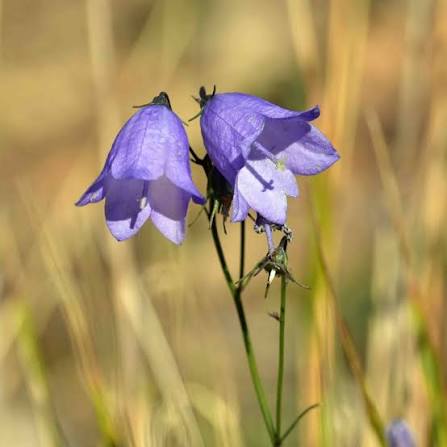
134.1860.Did the Harebell loose her girdle
Did the Harebell loose her girdle
To the lover Bee
Would the Bee the Harebell hallow
Much as formerly?
Did the “Paradise”—persuaded—
Yield her moat of pearl—
Would the Eden be an Eden,
Or the Earl—an Earl?
……………………………………………………………………………….
””””””””””””””””””””””””””””””””””””””””””’
My interpretation of ‘Did the Harebell loose her girdle’ [F134]:
Stanza 1.
Did the Harebell loose her girdle
To the lover Bee
Would the Bee the Harebell hallow
Much as formerly?
S1.
If the Harebell consented to sexual intercourse with lover Bee, would Bee still respect her in the morning?
Stanza 2.
“Did the “Paradise”—persuaded—
Yield her moat of pearl—
Would the Eden be an Eden,
Or the Earl—an Earl?”
S2.
If my vagina [paradise] were persuaded [or “seduced”] to yield its hymen [moat] to my lover, would our romantic love still exist, would my lover’s reputation be ruined?
………………………………………………………………………………………………..
ED copied neither this poem (F134) nor the preceding F133, ‘Mute – thy Coronation —’, into her fascicles even though she copied other poems of this vintage into fascicles.
…………………………………………………………………………………..
Almost all publications of this poem ignore ED’s underlining of four words: Line 3, “hallow”; Line 5, “persuaded”; Line 7, “be”; and Line 8, the second “Earl”. These omissions deny the reader important information. ED intended those words to be emphasized.
…………………………………………………………………………………………
A chronological timeline places this poem at a critical and vulnerable interval of ED’s life:
1855 March – ED, age 24, attends one of Rev. Wadsworth’s sermons and falls in love with him, from a distance.
1860 March – Rev. Charles Wadsworth visits ED in Amherst.
1860 “Second half” (Franklin) – ED composes ‘Mute — thy Coronation (F133)’
1860 “Second half” (Franklin) – ED composes ‘Did the harebell loose her girdle (F134)’
1861 Early – ED drafts the second surviving “Master” letter
1861 Summer – ED drafts the third surviving “Master” letter
Reverend Wadsworth (1814-1882) was a charismatic Presbyterian pastor at a large church in Philadelphia. He was 16 years older than ED, married and had two children.
………………………………………………………………………………………..
Given the chronological timeline, Wadsworth was probably the intended recipient of the three “Master Letters” and the protagonist of F133 and F134.
Reverend Wadsworth’s response to one ED’s letters shows deep concern for her mental and emotional condition:
“My Dear Miss Dickenson [sic]
“I am distressed beyond measure at your note, received this moment, – I can only imagine the affliction which has befallen, or is now befalling you.
“Believe me, be what it may, you have all my sympathy, and my constant, earnest prayers.
“I am very, very anxious to learn more definitely of your trial- and though I have no right to intrude upon your sorrow yet I beg you to write me, though it be but a word.
“In great haste
Sincerely and most
Affectionately Yours –“
The manuscript is unsigned and without date, but is in the handwriting of the Reverend Charles Wadsworth, with an embossed crest, “C.W.”
………………………………………………………………………..
In Line 1, ED uses the archaic verb “loose”. The ‘Emily Davidson Lexicon’ defines “loose” as “Release; unbind; set free; remove the restraints from”. Many other dictionaries also define it as “untie”.
Today, the use of the verb “loose” in the sense of “untie” is extremely rare. However, classic literature texts use the archaic form, “loose”, frequently. For example, The verb “loose” or its other forms, “loosed” and “looseth”, are used 63 times in ED’s copy of the King James Bible. (Google AI).
ED knew her Bible backward and forward, which probably explains her use of “loose” in Line 1 of this poem.
……………………………………………………………………………………………
Susan Kornfeld, founder of the Emily Dickinson poetry blog, ‘The Prowling Bee‘, posted a delightful explication of this poem on November 21, 2011:
“A delightful proto-feminist poem, Dickinson is wondering why there are sexual double standards for men versus women. The lovely harebell has perhaps loosened her girdle (“belt” we would say today) to that rogue lover Bee (lucky insect – he gets to stand in for God sometimes, too). The Big Question is: Will he still respect her in the morning? Dickinson selects the word “hallow” – even italicizing it for emphasis to show she really means it – to suggest a religious aspect. Marriage is a sacrament, but just a bit of fun between bees and flowers… well, maybe the Bee is right not to feel that hallow feeling. Except the reader senses this is wrong. The Bee would be quite foolish, as well as stupefyingly arrogant to feel anything other than yummy delight at the Harebell’s delicious, life-giving nectar.
“But just in case the reader is too thick skulled to follow the metaphor, the poet then moves us closer to the realm of ordinary men and women. “Paradise” is of course a way of referring to that blissful refuge men might find beyond the “moat of pearl” when making love. Here the lover is an Earl (helpfully rhyming with “pearl” or else he might have been a king) and if he had successfully “persuaded” his lady love to “yield” to him, the poet wants to know if Paradise / Eden would still be the same. Or would it become, say, Paradise Lost? Or worse, the lady just some now used-goods fallen woman. But the Earl – would he, too, undergo degradation? Dickinson doesn’t even bother to answer that last question. Yes, the Earl will still be an Earl no matter how many virgins he deflowers.
“The poem is a very playful and clever way of pointing out this inequity that still bedevils much of the world – and in some countries can be a life-and-death matter.
“The poem also is fun to read aloud – it just trips off the tongue. The “Did the” and “Would the” doublings strengthen the metaphor and give a nursery-rhyme feel to this adult-content poem. The rhymes are fun: Bee / formerly; and pearl / Earl. The four 4-letter-word “e”s of the last two lines not only link together visually, but showcase Dickinson’s gift for compaction. In both lines she uses the E word first as a specific and then as a general case. Would the Eden of this blossom still be in the category of unsullied Paradise? Would this particular Earl still belong in the category of princely nobility denoted by “Earl”?”
…………………………………………………………………………………………….
Between June 18, 2011 and January 30, 2024 Susan Kornfeld wrote and published explications on the first 878 of Emily Dickinson’s known 1789 poems (Poems F1-F878). Since then, Susan has continued to read and occasionally comment on poems.
The new explicator on ‘The Prowling Bee’ blog is Adam Wade DeGraff, who published his first explication on Poem 879 on February 17, 2026, and is currently (September 18, 2026) writing an explication on Poem 946. Doing the math, that’s 66 poems in 213 days, a prodigious rate of one poem every 3 days — not bad for a guy with a family and a full-time teaching job.
………………………………………………………………………………….
862.1864.On the Bleakness of my Lot
On the Bleakness of my Lot
Bloom I strove to raise –
Late – my Garden {Acre} of a Rock
Yielded Grape – and Maise –
Soil of Flint, if steady {steadfast} tilled
Will refund {reward, repay} the Hand –
Seed of Palm, by Lybian Sun
Fructified in Sand –
…………………………………………………………………………………….
I think this poem (F862) is only superficially about ED’s garden. It is well known that ED experienced four years (1861-1865) of emotional and mental pain that fueled a prodigious outburst of poems:
1850 1
1852 1
1853 1
1854 1
1855 0
1856 0
1857 0
1858 43
1859 82
1860 54
1861 88
1862 227
1863 295
1864 98
1865 229
1866 10
1867 12
1868 11
1869 11
1870 28
1871 48
1872 35
1873 38
1874 38
1875 34
1876 31
1877 42
1878 23
1879 35
1880 26
1881 25
1882 27
1883 34
1884 42
1885 13
1886 2
Total 1789
As she told Higginson in her second letter to him (JL261, April 25, 1862):
“I had a terror—since September—I could tell to none—and so I sing, as the Boy does by the Burying Ground—because I am afraid—”.
Something horrible happened to ED in September 1861. I think Reverend Charles Wadsworth told her he would be moving to San Francisco in 1862 to pastor the new, struggling Calvary Presbyterian Church, triggering her well documented separation anxiety.
……………………………………………………………………………………………
My biographical interpretation of F862, ‘On the bleakness of my lot’, with ED’s alternative words in {curly brackets}:
Stanza 1:
On the Bleakness of my Lot
Bloom I strove to raise –
Late – my Garden {Acre} of a Rock
Yielded Grape – and Maise –
S1:
In Line 1, “On the Bleakness of my Lot”, the meaning of “Lot” can be interpreted as the area of her garden or it can be interpreted as the cards life has dealt her. I think ED means her “Lot” in life. She spent five years cultivating her relationship with Wadsworth by mail – the “Bloom I strove to raise”, which yielded a visit from the superstar minister from Philadelphia in summer, 1860.
As I have argued in several earlier comments, e.g., F860, 1864, “No Notice gave She, but a Change —“, they consummated their [her imagined?] long-distance love affair that evening in the Dickinson orchard, after which he took the train 12 miles back to Northampton where was visiting his best friend. He then returned to Philadelphia by train, a trip of 250 miles.
Line 3 further supports the “Lot in life” interpretation because her “Garden” was not a “Rock”. Before 1813, her grandfather had purchased a large lot that probably was forested with eastern white pine (Pinus strobus), the usual early-successional species of tree in western New England. (See 849.1864.By my Window have I for Scenery).
The original late-successional hardwoods – eastern red oak (Quercus rubus), Chestnut (Castanea dentata), and hickories (Carya spp.) – would have been cut during the late 1700s to build Amherst (fully incorporated in 1775).
ED’s grandfather would have chosen the gentle south slope for ‘Homestead’ because of its uneroded soil and south aspect that would catch the New England winter sun. These biographical details immediately inform us that this poem is not about ED’s garden but about “the Bleakness of my Lot” in life. When ED tells us “my Acre of Rock”, she is probably speaking about Wadsworth not responding to her pleas for him to visit again:
“Wont he [you] come to her-or will he let her seek him, never minding [whatever] so long wandering [out] if to him at last.” (Master Letter F2, J3, early 1861).
“Could you come to New England- [this summer-could] would you come to Amherst – Would you like to come – Master?” (Master Letter F3, J2, summer 1861).
Twenty years later, in 1880, Wadsworth did make a second visit to Amherst in response to ED’s camouflaged invitation:
1485.1879.Spurn the temerity (F1485, 1879)
“Spurn the temerity –
Rashness of Calvary –
Gay were Gethsemane
Knew we of thee –“
Yes, in 1864, ED can raise maize or grapes, but not the “Bloom I strove to raise”, which was love.
Stanza 2:
Soil of Flint, if steady {steadfast} tilled
Will refund {reward, repay} the Hand –
Seed of Palm, by Lybian Sun
Fructified in Sand –
S2
In Line 5, I prefer ED’s original “steady” because her alternate “steadfast” seems wrong for an adverb for “tilled”. In Line 6 I prefer her alternate word, “reward” because, if Wadsworth did visit, it would be a “reward”, not a repayment of a debt he owes her. The very fact that she left “refund” as her verb suggests she viewed their relationship as transactional, but no one ever said ED was socially skilled.