802.1864.The spry Arms of the Wind
“About early 1864, in pencil on both sides of an envelope addressed to Miss Emily Dickinson (a140)” (Franklin 1998)
I prefer all three of ED’s alternate words (parentheses in Lines 1 & 10):
The spry (long) Arms of the Wind
If I could crawl between
I have an errand imminent
To an adjoining Zone—
I should not care to stop
My Process is not long
The Wind could wait without the Gate
Or stroll the Town among.
To ascertain the House
And is (if) the soul (soul’s) at Home
And hold the Wick of mine to it
To light, and then return—
My interpretation of ‘The spry Arms of the Wind’ in three prose paragraphs, one for each stanza:
Stanza 1: “The (long) Arms of the Wind” separate Earth and Heaven, which is “an adjoining Zone”. I would like to “crawl between” those “Arms” because I have “an errand imminent” in Heaven.
Stanza 2: Not only is my “errand imminent”, it will also be quick: “My process is not long”. ED then suggests “The Wind could wait outside the Gate / Or stroll the Town” within, AKA Heaven.
Stanza 3: My “errand imminent” is to “ascertain the House” where Wadsworth’s soul lives “and, if the soul’s at Home”, to “hold the Wick of my soul to it / to light, and then return” to Earth with Wadsworth’s flame of “Life Force”, her muse’s poetic inspiration, the thing that makes my life worth living.
……………………………………
Franklin (1998) describes the Fr802 manuscript: “About early 1864, in pencil on both sides of an envelope addressed to “Miss Emily Dickinson” (a140). The “a140” indicates this manuscript is Item “#140 in the Amherst College Emily Dickinson collection.
802.1864.The spry Arms of the Wind
“About early 1864, in pencil on both sides of an envelope addressed to Miss Emily Dickinson (a140)” (Franklin 1998)
I prefer all three of ED’s alternate words (parentheses in Lines 1 & 10):
The spry (long) Arms of the Wind
If I could crawl between
I have an errand imminent
To an adjoining Zone—
I should not care to stop
My Process is not long
The Wind could wait without the Gate
Or stroll the Town among.
To ascertain the House
And is (if) the soul (soul’s) at Home
And hold the Wick of mine to it
To light, and then return—
My interpretation of ‘The spry Arms of the Wind’ in three prose paragraphs, one for each stanza:
Stanza 1: “The (long) Arms of the Wind” separate Earth and Heaven, which is “an adjoining Zone”. I would like to “crawl between” those “Arms” because I have “an errand imminent” in Heaven.
Stanza 2: Not only is my “errand imminent”, it will also be quick: “My process is not long”. ED then suggests “The Wind could wait outside the Gate / Or stroll the Town” within, AKA Heaven.
Stanza 3: My “errand imminent” is to “ascertain the House” where Wadsworth’s soul lives “and, if the soul’s at Home”, to “hold the Wick of my soul to it / to light, and then return” to Earth with Wadsworth’s flame of “Life Force”, her muse’s poetic inspiration, the thing that makes my life worth living.
……………………………………
Franklin (1998) describes the Fr802 manuscript: “About early 1864, in pencil on both sides of an envelope addressed to “Miss Emily Dickinson” (a140). The “a140” indicates this manuscript is Item “#140 in the Amherst College Emily Dickinson collection. In 1958, Mabel Todd’s daughter, Millicent Todd Bingham, gave ED’s manuscripts of Fr801 and Fr802 (a140 and a438) to the Amherst College Library. (Google AI)
My inference is that ED wrote Fr801 on the first envelope Eliza sent to ED, folded it, and placed it inside a cover envelope that she addressed to Eliza.
What Franklin doesn’t tell us is that the folded envelope with ED’s poem “on both sides” includes her last two lines on the outside of the flap used to seal the original envelope and that her last two poem lines straddle Eliza’s elegantly written “Miss Emily Dickinson”. Eliza indicated the double “ss” in “Miss” with the German “eszett” symbol, ß.
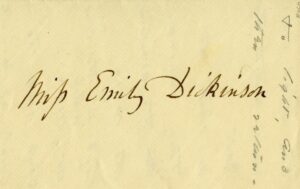
Eliza knew ED would recognize the “eszett” symbol because in 1847, when ED was 16, she and Eliza had studied German together at Amherst Academy (Habegger 2001). Given this information, when ED wrote Fr802 the friendship between her and Eliza had lasted 17 years (1847-1864).
For a list of reasons why I think both Fr801 and Fr802 are about Wadsworth, see my explication of Fr801 on the ED-LarryB blog.
Franklin, R. W. 1998. THE POEMS OF EMILY DICKINSON: VARIORUM EDITION. Edited by R. W. Franklin. 3 vols. Cambridge, MA: Belknap P of Harvard UP, 1998. vi + 1654 pp.
Habegger, Alfred. 2001. My Wars Are Laid Away in Books: The Life of Emily Dickinson Random House Publishing Group. Kindle Edition.