808.1864.The lovely flowers embarrass me

The lovely flowers embarrass me,
They make me regret I am not a Bee –

Text of Letter M&ML422, JL1042 to Lucretia Gunn Bullard, ED’s aunt, about late spring 1864, Cambridge, MA:

“The lovely flowers embarrass me,
They make me regret I am not a Bee –

Was it my blame or Nature’s?

Thank you, dear Aunt, for the thoughtfulness, I shall slowly forget – The beautiful Plant would entice me, did I obey myself, but the Doctor is rigid –

Will you believe me grateful,

Truly,

Emily

Given ED’s disinclination for visiting, she’s got a good excuse. I agree with Johnson (1958), the poem is a poet’s polite RSVP for a medical reason

Cristanne Miller and Domhnall Mitchell, 2024, The Letters of Emily Dickinson, Harvard University Press. Kindle Edition.

807.1864.Away from Home are some and I —

807.1864.Away from Home are some and I —

Away from Home are some and I —
An Emigrant to be
In a Metropolis of Homes
Is easy, possibly —

The Habit of a Foreign Sky
We — difficult — acquire
As Children, who remain in Face
The more their Feet retire.

My interpretation of  Fr807:

  1. Away from home are some and I; to be an emigrant in a large city of homes is easy, possibly.
  2. The habit of a foreign sky we difficult acquire, as children who remain home in heart the more their faces leave home.


A biographical interpretation makes the meaning of this poem clear; I think ED intended Line 1 to be read literally, “Away from Home are some and I —”:

  1. During late April to November 21 in 1864, ED lived with her cousins in Cambridge where she could get treatments by the best ophthalmologist in Boston. She was an “Emigrant” because she left her home in Amherst by train bound for Boston, which was a “Metropolis of Homes” compared to Amherst. The train ride was “easy”, but she’s uneasy about what lies ahead, hence the stanza-closing “possibly —”
  2. Getting used to the “Foreign Sky” of Cambridge and Boston wasn’t easy for ED, a small-town girl who liked her home on Amherst’s Main Street. She felt like a child whose “face” was physically in an unfamiliar place where she was supposed to be, but her heart and brain remained in her second-floor bedroom at Homestead writing poetry, or at least trying to. (Habegger 2001)

She used the word “Emigrant” because her travel experience helped her empathize better with the Irish immigrants in Amherst who had arrived in a strange new land under a “Foreign Sky”.

During ED’s months of treatment she apparently composed some poems. However, she was under strict orders not to use her eyes, so she may have dictated new poems to her cousins, Louisa and Francis Norcross. That may explain some of the upcoming short poems.

Habegger, Alfred. 2001. My Wars Are Laid Away in Books: The Life of Emily Dickinson. Random House Publishing Group. Kindle Edition.

806.1864.Partake as doth the Bee

806.1864.Partake as doth the Bee,

ED’s alternate Lines 3-4 in parentheses:

Partake as doth the Bee,
Abstemiously.
The Rose is an Estate—         (I know the Family)
In Sicily.                                 (In Tripoli).

Johnson (1955) tells us:

“The diary of ED’s cousin, Perez Dickinson Cowan, who was graduated from Amherst College in 1866, under date of 26 April 1864, records that ED presented him with a bouquet of flowers with this poem [Variant 803B] enclosed as a note.”

Perez Dickinson Cowan (1843-1923) was born and raised in Knoxville, Tennessee. He was 20 or 21 when ED wrote this poem. Tennessee was a Confederate state, and Cowan was a student at Amherst College during the Civil War. East Tennessee leaned toward the Union, as did Cowan’s family, and ED’s father was Cowan’s uncle once removed, which may explain Cowan’s presence at Amherst College, a safe refuge for a draft-age, privileged southern boy.

That Perez graduated late, at age 23 in 1866, and after Lee’s 1865 surrender, supports this conjecture.

ED tells us, “I know the Family”. Also, her three-syllabled “Tripoli” is likely a camouflaged alliteration for three-syllabled “Tennessee”. Clearly, ED was being extremely careful to avoid implicating her second cousin or his Knoxville family in draft-dodging.

805.1864.These Strangers, in a foreign World,

These Strangers, in a foreign World,
Protection asked of me—
Befriend them, lest Yourself in Heaven
Be found a Refugee—

The plural “Strangers” of Line 1 of “These Strangers, in a foreign World” suggests that a family of Irish immigrants, newly arrived from the potato famines of Ireland, are the recipient of ED’s generosity. She did the same earlier for a young boy, probably also Irish, in F486, 1862 (Stanza 1)

“He told a homely tale
And spotted it with tears —
Upon his infant face was set
The Cicatrice of years —”

The influx of Irish immigrants into Amherst was a result two things: the Irish potato famine of 1845-1855 and the completion of a railroad spur line to Amherst in 1853, a project sponsored by ED’s father . “During the Great Irish Potato Famine, between 1845 and 1855, an estimated 2.1 million Irish people emigrated from Ireland to North America, with the majority coming to the United States.” (Google AI).

Before Massachusetts banned slavery in 1783, many wealthy landowners in the upper Connecticut River Valley owned slaves. Their descendants were the domestic workers for wealthy families until the 1840s. During ED’s youth, the Dickinsons hired African Americans as gardeners, stable managers, and house maids. Several academic studies suggest traces of Negro dialect in ED’s letters and poems:

Fielder, Brigitte. 2022. “Emily Dickinson’s Black Contexts.” The Oxford Handbook of Emily Dickinson, edited by Cristanne Miller and Karen Sánchez-Eppler, OUP Oxford, pp. 353–71.

Murray, Aife. 2010. Maid as Muse: How Servants Changed Emily Dickinson’s Life and Language. University of Massachusetts Press, 299 pp.

Romer, Robert H., 2009, Slavery in the Connecticut Valley of Massachusetts, Levellers Press, 286 pp.

804.1864.Ample make this Bed—

804.1864.Ample make this Bed—

Ample make this Bed—
Make this Bed with Awe—
In it wait till Judgment break
Excellent and Fair.

Be its Mattress straight—
Be its Pillow round—
Let no Sunrise’ yellow noise
Interrupt this Ground—

My interpretation, or simple repeat, of this seemingly simple, imperative poem (Variant A):

  1. Ample make this bed, make this bed with awe; in it wait till judgement day, excellent and fair.
  1. Make it’s mattress straight, make it’s pillow round; let no sunrise’s yellow noise interrupt this ground.


ED’s misguided editors “corrected” her manuscript’s incorrect possessive, “it’s” in Lines 5-6.

Of the many ways to interpret this poem: Lines’ 2-3 command to “make” and “wait”, Lines’ 7-8 command to “Let no Sunrise’ yellow noise / Interrupt this “Ground”, and ED’s love-hate obsession with Death, my money’s on a coffin-bed in a fresh grave.


In 1883, one year after Wadsworth died and three years before ED’s death, a prominent Boston publisher, Thomas Niles, solicited her poems. She replied with a cryptic note and three poems:

“Dear friend –

“Thank you for the kindness.

“Please efface [erase] the others and receive these three, which are more like him – a Thunderstorm – a Humming Bird, and a Country Burial [F804]. . . . .”

Niles politely demurred.

ED’s letter to Niles is cryptic to me because she doesn’t identify “him”, but my first guess would be Rev. Charles Wadsworth, who had died one year earlier

Only two poems ago, Fr 802 suggested that ED did not know whether Wadsworth was still alive when she composed Fr803 and 804 in early 1864. In late 1863, 116 poems ago, in ‘To know just how He suffered’ (Fr688), ED obsessed about what Wadsworth said or might have said as he died.

Stanza 1 of 6:

To know just how He suffered – would be dear –
To know if any Human eyes were near
To whom He could entrust His wavering gaze –
Until it settled broad – on Paradise –

803.1864.Nature and God—I neither knew

803.1864.Nature and God—I neither knew

“Two fair copies, variant, about 1864 and 1865. A pencil copy signed “Emily” was sent to Samuel Bowles about early 1864” (a 698, Franklin 1998).

One alternate word in Line 5, but I prefer ED’s original “My” over its alternate, “an”, because it is more personal than “an” and because it’s in her 1864 first variant, which she sent to Bowles:

Nature and God—I neither knew
Yet Both so well knew me
They startled, like Executors
Of My (an) identity.

Yet Neither told—that I could learn—
My Secret as secure
As Herschel’s private interest
Or Mercury’s affair—


My interpretation of ‘Nature and God’ (Fr803) in two paragraphs, one for each stanza:

Stanza 1: I knew neither Nature nor God, yet both thought they knew me well. When they learned about my real identity, they startled, like surprised executors of my will.

Stanza 2: Yet neither told, as far as I could learn; my secret was as secure as William Herschel’s private life as a musician and composer, or Mercury’s love affair with Venus.


To ED, her relationship with Wadsworth would be much more surprising to “Nature and God” than knowledge that she was a world-class poet.


Aside from his astronomical discoveries, Herschel played violin, oboe, harpsichord, and organ. He composed 24 symphonies, several concertos, and church music. In addition, he served as a church organist in Bath and led a military band (Google AI).


Mercury, the Roman messenger god, had a romantic affair with Venus, the goddess of love, which resulted in the birth of their child, Hermaphroditos (Google AI).


ED’s deepest secret was that for five years (1856-1860), she had cultivated an epistolatory friendship with Philadelphia’s superstar Presbyterian minister, Reverend Charles Wadsworth. Apparently, ED shared knowledge of her relationship with no one except Eliza Coleman, her second cousin and close friend since childhood (see my explications of the two previous poems, Fr801 and Fr802). ED kept her friendship with Wadsworth a secret to protect both his reputation and her own.

The payoff for her long labor was his 1860 visit to her home in Amherst.

Apparently, during September 1861, Wadsworth informed ED that he would relocate to a different pulpit. What he didn’t tell her was his reason for leaving Arch Street Presbyterian. Though he sided with the Union politically, he firmly believed the Bible condoned slavery. Most of his Philadelphia congregation did not agree and asked him to resign.

Apparently, when Wadsworth told ED he would be relocating, ED went into an emotional tailspin of incredible poem production and bipolar depression. As she told Higginson in her second letter to him (JL261, MML338, postmarked April 28, 1862):

“I had a terror – since September – I could tell to none – and so I sing, as the Boy does by the Burying Ground, because I am afraid”

“Sing” she did; Franklin dates 227 poems to 1862 and 295 to 1863.

The only surviving letter from Charles Wadsworth to Emily Dickinson is dated “about late April, 1862” by M&M (2024). That he misspelled her name in the salutation suggests carelessness or ignorance:


“My dear Miss Dickenson [sic]

I am distressed beyond measure at your note, received this moment,—I can only imagine the affliction which has befallen, or is now befalling you

Believe me,—be what it may, you have all my sympathy, and my constant, earnest prayers—

I am very, very anxious to learn more definitely of your trial—and though I have no right to intrude upon your sorrows Yet I beg you to write me, though it be but a word;

In great haste

Sincerely and most
Affectionately Yours—”


Unsigned, but “Yours” underlined. The stationary had an embossed “C.W.” crest on it. Wadsworth never used that stationary after leaving Philadelphia.

Wadsworth says he replied immediately after receiving a disturbing “note” from ED, which would have been sometime in April 1862, just before he sailed from New York Harbor on May 1.


PS1. “The most crucial and — though she could not know it — historically eventful year in Emily Dickinson’s life was 1862. She was undergoing an emotional disturbance of such magnitude that she feared for her reason. At the same time she had developed her poetic sensibilities to a degree that impelled her to write Thomas Wentworth Higginson in April to learn what a professional man of letters might have to say about her verses. In no other year did she ever write so much poetry.” (Franklin 1986)


PS2. Google AI’s definition of executor: The person named in a will to manage a deceased person’s estate.


Franklin, RW (ed). 1986.The Master Letters of Emily Dickinson. Amherst College Press

Miller, Christine and Dohmnall Mitchell. 2024. The Letters of Emily Dickinson. Harvard University Press. Kindle Edition.
802.1864.The spry Arms of the Wind

802.1864.The spry Arms of the Wind
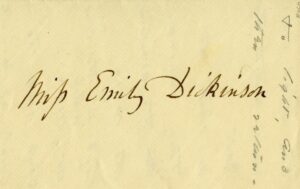
“About early 1864, in pencil on both sides of an envelope addressed to Miss Emily Dickinson (a140)” (Franklin 1998)

I prefer all three of ED’s alternate words (parentheses in Lines 1 & 10):

The spry (long) Arms of the Wind
If I could crawl between
I have an errand imminent
To an adjoining Zone—

I should not care to stop
My Process is not long
The Wind could wait without the Gate
Or stroll the Town among.

To ascertain the House
And is (if) the soul (soul’s) at Home
And hold the Wick of mine to it
To light, and then return—

My interpretation of ‘The spry Arms of the Wind’ in three prose paragraphs, one for each stanza:

Stanza 1: “The (long) Arms of the Wind” separate Earth and Heaven, which is “an adjoining Zone”. I would like to “crawl between” those “Arms” because I have “an errand imminent” in Heaven.

Stanza 2: Not only is my “errand imminent”, it will also be quick: “My process is not long”. ED then suggests “The Wind could wait outside the Gate / Or stroll the Town” within, AKA Heaven.

Stanza 3: My “errand imminent” is to “ascertain the House” where Wadsworth’s soul lives “and, if the soul’s at Home”, to “hold the Wick of my soul to it / to light, and then return” to Earth with Wadsworth’s flame of “Life Force”, her muse’s poetic inspiration, the thing that makes my life worth living.

……………………………………

Franklin (1998) describes the Fr802 manuscript: “About early 1864, in pencil on both sides of an envelope addressed to “Miss Emily Dickinson” (a140). The “a140” indicates this manuscript is Item “#140 in the Amherst College Emily Dickinson collection.

802.1864.The spry Arms of the Wind
“About early 1864, in pencil on both sides of an envelope addressed to Miss Emily Dickinson (a140)” (Franklin 1998)

I prefer all three of ED’s alternate words (parentheses in Lines 1 & 10):

The spry (long) Arms of the Wind
If I could crawl between
I have an errand imminent
To an adjoining Zone—

I should not care to stop
My Process is not long
The Wind could wait without the Gate
Or stroll the Town among.

To ascertain the House
And is (if) the soul (soul’s) at Home
And hold the Wick of mine to it
To light, and then return—

My interpretation of ‘The spry Arms of the Wind’ in three prose paragraphs, one for each stanza:

Stanza 1: “The (long) Arms of the Wind” separate Earth and Heaven, which is “an adjoining Zone”. I would like to “crawl between” those “Arms” because I have “an errand imminent” in Heaven.

Stanza 2: Not only is my “errand imminent”, it will also be quick: “My process is not long”. ED then suggests “The Wind could wait outside the Gate / Or stroll the Town” within, AKA Heaven.

Stanza 3: My “errand imminent” is to “ascertain the House” where Wadsworth’s soul lives “and, if the soul’s at Home”, to “hold the Wick of my soul to it / to light, and then return” to Earth with Wadsworth’s flame of “Life Force”, her muse’s poetic inspiration, the thing that makes my life worth living.

……………………………………

Franklin (1998) describes the Fr802 manuscript: “About early 1864, in pencil on both sides of an envelope addressed to “Miss Emily Dickinson” (a140). The “a140” indicates this manuscript is Item “#140 in the Amherst College Emily Dickinson collection. In 1958, Mabel Todd’s daughter,  Millicent Todd Bingham, gave ED’s manuscripts of Fr801 and Fr802 (a140 and a438) to the Amherst College Library. (Google AI)


My inference is that ED wrote Fr801 on the first envelope Eliza sent to ED, folded it, and placed it inside a cover envelope that she addressed to Eliza.

What Franklin doesn’t tell us is that the folded envelope with ED’s poem “on both sides” includes her last two lines on the outside of the flap used to seal the original envelope and that her last two poem lines straddle Eliza’s elegantly written “Miss Emily Dickinson”. Eliza indicated the double “ss” in “Miss” with the German “eszett” symbol, ß.

Eliza knew ED would recognize the “eszett” symbol because in 1847, when ED was 16, she and Eliza had studied German together at Amherst Academy (Habegger 2001). Given this information, when ED wrote Fr802 the friendship between her and Eliza had lasted 17 years (1847-1864).

For a list of reasons why I think both Fr801 and Fr802 are about Wadsworth, see my explication of Fr801 on the ED-LarryB blog.


Franklin, R. W. 1998. THE POEMS OF EMILY DICKINSON: VARIORUM EDITION. Edited by R. W. Franklin. 3 vols. Cambridge, MA: Belknap P of Harvard UP, 1998. vi + 1654 pp.

Habegger, Alfred. 2001. My Wars Are Laid Away in Books: The Life of Emily Dickinson Random House Publishing Group. Kindle Edition.